

Hidden deep within dense woodland and rolling hills 100 miles or so south of Stuttgart sits Mercedes-Benz's vast Immendingen proving ground.
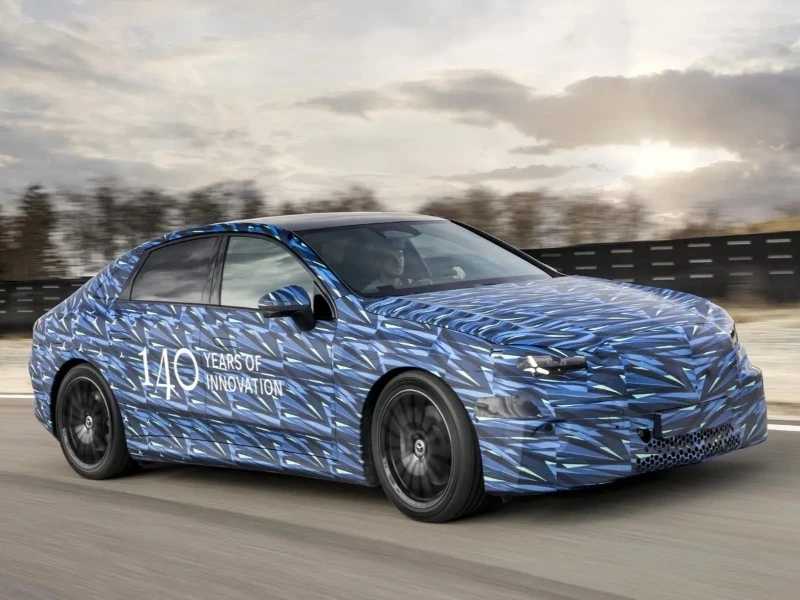
A small group of engineers and two disguised prototypes recently awaited us behind heavily secured gates, and the facility's complex of handling tracks, durability routes and engineering workshops, where the company signs off new models before they reach production, recently provided the setting for our first close look at the upcoming electric C-Class.
Even through the strategic camouflage, their significance is clear. For more than three decades, the internal combustion engine C-Class has been one of Mercedes-Benz's key global models in terms of sales, and the new electric version is expected to carry a similar responsibility as the German automaker expands its electric model line-up into higher-volume and more profit-oriented segments.
Tesla's Model 3 has held a commanding sales position for years. Now BMW is preparing to introduce its new i3 sedan, the electric equivalent of its signature 3 Series, while Audi is also planning to follow with an electric A5 before the end of the decade. And Mercedes-Benz is preparing to take them on with a new generation of electric vehicle technology.
Dedicated MB:EA electric vehicle architecture
The electric C-Class, known internally under the development code W520, is based on Mercedes-Benz's MB.EA platform, an entirely new architecture developed specifically for midsize electric vehicles and shared with the recently unveiled electric GLC SUV.
The skateboard-style platform supports an 800-volt electrical system and a new family of Mercedes-Benz-developed electric motors that will allow the new sedan to be offered with both rear-wheel drive and four-wheel drive configurations.
The development prototypes we ride in today are both initial top-of-the-range C400 4Matic Electric versions, engineers confirm. Mercedes-Benz is keeping official figures under wraps ahead of the model's formal debut next month, but we're told its drivetrain closely mirrors that of the GLC 400 4Matic Electric unveiled late last year and due for U.S. sale next year.
This points to output in the region of 483 hp and 596 lb.-ft. of torque delivered through two electric motors. The primary motor sits at the rear axle and features a two-speed transmission, while a second motor integrated into the front axle provides additional performance and traction when called upon.
Battery sizes vary depending on the model. Engineers say the electric C-class line-up will eventually include packs ranging from around 64 kWh to 94 kWh, with the largest capable of delivering more than 435 miles of range on the WLTP cycle. Mercedes-Benz estimates an EPA figure in the region of 380 miles.
Maximum DC fast-charging capacity will reach 330 kW, again matching the specification of the electric GLC.
Mercedes-Benz has yet to publish official specifications, but it says buyers should expect a model structure broadly similar to that of the GLC Electric lineup. For the U.S., this suggests a rear-wheel-drive C300+ using a single rear-mounted electric motor, alongside the C300 4Matic and the C400 4Matic experienced in our preview.
An even more extreme model is already under development. Mercedes-AMG engineers are working on a high-performance flagship using three axial-flux electric motors and a new round-cell battery concept.
Traditional sedan proportions
Despite the heavy camouflage, the prototypes provide clear clues about Mercedes-Benz's evolving electric design direction. Earlier upmarket offerings such as the EQE and EQS adopted a more radical, cab-forward silhouette shaped primarily by aerodynamic efficiency.
The new C-Class Electric returns to a more conventional sedan profile, though with sufficient visual distinction from the existing internal combustion engine C-Class to set it apart immediately.
Two elements stand out. The front end incorporates Mercedes-Benz's new illuminated "Iconic" grille, first seen on the GLC Electric, giving the car a more upright and assertive look. At the rear, however, the design marks a more noticeable shift. The rear window is set at a shallow angle, giving the electric C-Class a fastback-like appearance even though it retains a conventional trunk lid.