

Chinese automakers including SAIC Motor, Changan, Great Wall Motor, BYD, Li Auto and Geely, are preparing to launch models equipped with 100% homemade chips, with at least two brands aiming to start mass production as early as 2026.
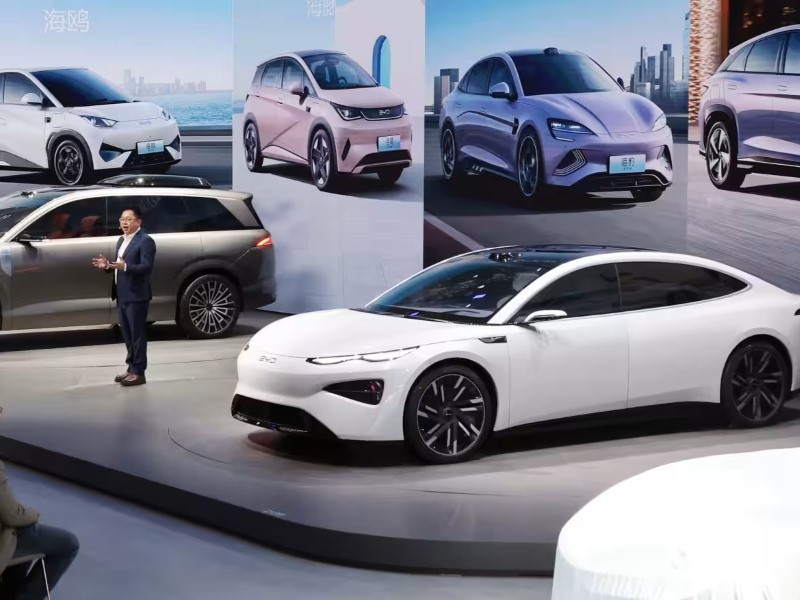
The first of these models to be mass-produced will be the newest versions of existing lines made by a few brands, with more makers to follow, according to people familiar with the situation. These efforts are part of Beijing's ambitious vision for increasing the country's self-reliance in chips amid intensifying tensions with the U.S.
The project is shepherded by China's Ministry of Industry and Information Technology (MIIT), which regularly calls on automakers, particularly the state-owned ones, to conduct self-assessments of their domestic chip adoption rates, the people said.
The latest policy target is to use 100% self-developed and made automotive chips by 2027, three people briefed on the matter said. This is a significant acceleration of the government's previous target of having domestic automakers using 25% homemade chips this year.
However, the 100% target is not mandatory, the sources said. Instead, it is more a framework that incentivizes companies to reassure Beijing that they can meet its goals and are working hard to do so.
The criteria for calculating automotive chips' self-sufficiency rate remain unclear, with some interpreting it as being based on the total number of chips used in vehicles, while others suggest it is determined by how many types of chips used are developed or made locally, sources briefed on the matter said.
The majority of top Chinese automakers, including SAIC, FAW Group, GAC Group, BYD, Geely, Changan and Great Wall, have been asked by the government to increase their use of locally made or developed chips, sources said. An executive with a Chinese chip developer told Nikkei that some of its carmaking customers such as Geely have told them they would prioritize using locally developed chips if those options existed, and said they prefer chips from Chinese domestic players over foreign chip developers even if those chips can be produced locally.
Some car groups, such as GAC Group, are working closely with Chinese contract chipmakers Semiconductor Manufacturing International Corp. and CanSemi Technology to review the whole automotive chip supply chain and facilitate verification of locally developed alternatives, according to a person briefed on the matter.
Chinese automakers have been heavily reliant on U.S. or other foreign made chips, particularly in autonomous driving systems, and several suppliers told Nikkei that clients have told them that rapidly shifting to 100% domestic supplies would be challenging. High-end Chinese cars still use Nvidia's AI chips designed for cars, or Qualcomm's chip solutions for smart cockpits and self-driving related features. Progressive moves by Washington to restrict China's access to American technologies are raising fears that Chinese automakers could be left without access to needed components.
Against this backdrop, global automotive chip leaders such as STMicroelectronics, NXP and Infineon have been increasing their collaborations with Chinese contract chip manufacturers to boost production for China-based carmakers. Infineon CEO Jochen Hanebeck told Nikkei in an interview that Chinese clients were asking the chipmaker to localize production of chips for their home market.
Beijing's drive to reduce dependence on foreign suppliers, coupled with automakers' desire to keep costs down, is driving a fundamental change in the automotive chip supply chain in China.
In the past, automotive chips had to go through strict testing, including enduring harsh outdoor conditions, a process that could take up to five years from development to qualification. Now, according to executives from several chip developers, display makers and printed circuit board makers, Chinese EV makers are taking a much more flexible approach, such as using consumer-grade and already-available chips for some noncritical features like infotainment systems.
"It takes us some three to five years to go through the qualification process for European carmakers, but it only takes six to nine months for testing and qualification for Chinese automobile makers," a manager with a Chinese display maker told Nikkei. "On top of the localization demand, this is our opportunity to expand our home-market business."
An executive with another display maker said all of its Chinese automobile customers are becoming more aggressive in their attempts to localize supplies, even for chips and components used in the sub-systems in the cars. "We are required to replace not only driver ICs with China-made chips, but also some components and materials, such as optical films that are currently dominated by U.S. companies. We have to switch them to Chinese suppliers by next year at the earliest," the executive said.
Driver ICs control another circuit or component by regulating the flow of current.
Chips used in cars have traditionally been microcontrollers, sensors and analog chips for controlling such things as lights, windows, brakes, temperature and safety features. But with the growth of autonomous and electrified features and the rise of EVs, the number of chips per car -- both logic and analog -- has increased significantly, with more chips needed for computing, motors, cameras and displays, as well as battery and power management systems.
Most of these automotive chips can be built with older generation chipmaking machines, making it easier for China to make more of them domestically.
Brian Matas, an analyst with TechInsights, said China has been very aggressive in ramping its mature node technology, which has put pricing pressure on some chip product segments.
"Specifically, the analog market and a large portion of the microcontroller units (MCUs) market have endured a few years of soft market growth due in part to pricing pressures on these devices that are built mostly on mature process nodes," Matas said.
However, China still has a long way to go to increase its total self-sufficiency, he added. For 2025, China's total local production for integrated circuits can meet about 17.5% of its total market of roughly $185 billion, TechInsights estimates.
According to SEMI, production capacity inside China for mature nodes -- defined as chips produced with 14-nanometer or less advanced technology -- could account for nearly 40% of global total capacity by 2027, from 31% in 2023. U.S. production of such chips will stand at around 5%.
Geely declined to comment for this story. Other companies did not respond to requests for comment.