

Chinese electric-vehicle manufacturers have started raising prices in Thailand now that the country has ended purchase subsidies, signaling a change in Southeast Asia's leading EV market.
At a BYD dealership just outside of Bangkok, EV presale orders have dropped substantially this year, a salesperson said.
"The price increases are making some customers hesitant to buy," the worker said.
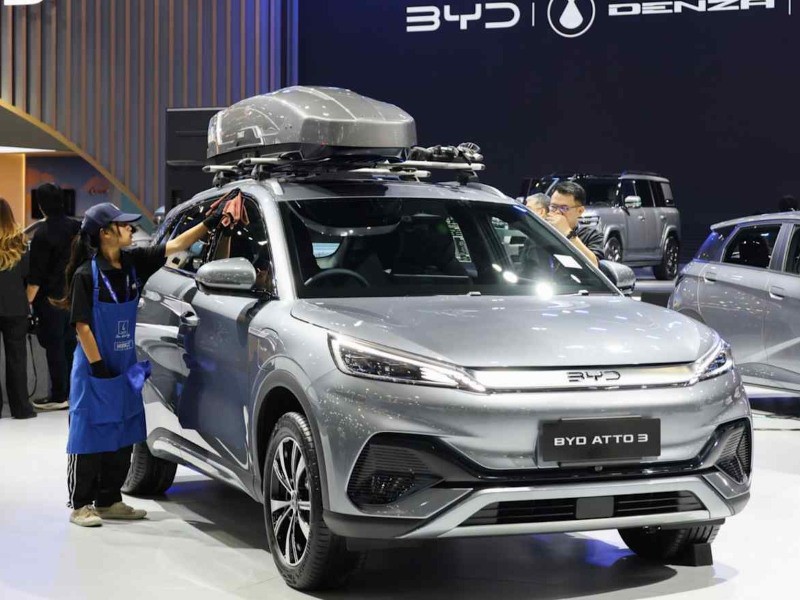
The Dolphin, BYD's bestselling compact hatchback EV, had a sticker price of 599,900 baht ($19,300) for the standard version as of Tuesday -- 33% higher than the lowest price in 2025. The Atto 3 all-electric sport utility vehicle is priced at 849,900 baht, a 21% hike.
This is the first time BYD has raised prices since entering the Thai market in 2022. But China's leading EV maker is hardly alone.
Shanghai-based SAIC Motor's MG, the second-largest EV brand in Thailand, raised the price of its MG4 electric hatchback by 30,000 baht. MG's Maxus 9 Plus luxury minivan is up by 50,000 baht.
Guangzhou Automobile Group, Chery Automobile and Zhejiang Geely Group Holding have raised prices, too, local media report.
Thailand has offered subsidies for EV makers that entered the market and produced vehicles locally, but the incentives were phased out by the end of last year. Big Chinese players such as BYD would benefit from as much as 150,000 baht per vehicle.
This affordability drove the expansion of electric vehicles in Thailand. Last year, 122,128 EVs were sold in the Southeast Asian country, up 74% from 2024, media outlet Auto Life Thailand reports. EVs accounted for 24% of new-car sales.
"With subsidies ending, we have no choice but to change our prices," Pratarnwong Phornprapha, CEO of BYD-backed distributor Rever Automotive, told reporters at an auto show in November.
At the same time, the end of the subsidies presents an opportunity to rein in price competition.
"EV prices have been distorted by excessive price cuts," said Shuhei Hashimoto, an expert on Thai industry at the German consultancy Roland Berger. Chinese automakers "aim to normalize prices to a sustainable level by raising them."
BYD, which led the price war, faced a particularly strong backlash. Consumers have criticized the company for causing the value of trade-ins to fall.
The Atto 3 was priced roughly 40% lower at the end of 2025 compared with the model's launch. Other Chinese manufacturers expressed concern about BYD's discounting, and some consumers sought to file a class action lawsuit.
Strong EV sales helped Chinese automakers gain ground across Thailand's auto market, including gasoline-powered vehicles. Chinese players' share of new-car sales quadrupled to 22% in 2025 from 2022, auto industry research firm MarkLines reports.
Meanwhile, the share for Japanese automakers shrank by nearly one-fifth to 68%, but they have an opportunity in the price hikes by Chinese rivals.
Toyota Motor is selling its flagship hybrid sedan, the Yaris Ativ, at the regular price of 729,000 baht. Honda Motor's e:N1, an EV model imported from China, starts at 1,199,000 baht, making it the cheapest Japanese EV model. Some Japanese hybrids and EVs have become more affordable than Chinese electrics.
"2026 will be the year we see true EV demand after subsidies end," Hashimoto said. "It will be necessary to monitor how the impact of prices and inventory levels of EVs produced in Thailand will spread to neighboring countries."